
Montana Aerospace Featured in One of the Leading Aerospace magazin
The future of aviation is being shaped today - and Montana Aerospace is part of that conversation.
In two recent articles published by the renowned industry magazine Aviation Week last week, our company is highlighted as an important partner for future aircraft programs and innovative structural solutions.
The article explores emerging aircraft structure concepts, including hybrid solutions, composite materials and advanced manufacturing technologies, and highlights how Montana Aerospace contributes its engineering expertise in metallic and hybrid structures while continuously advancing future technologies through its R&D activities.
We are proud to see our work and capabilities gaining visibility in one of the leading publications serving the aerospace industry.
This article has been provided exclusively for internal use within Montana Aerospace.
Please do not forward, share, or distribute it outside the company.
Enjoy the read!
A special THANK YOU to our engineering teams who are the driving force behind all these developments. As well as our colleagues John Daniels (Chief Technical Office)and Andy Vanaerschot, (Senior Program Manager
Asco) for providing valuable insights and background information that contributed to these two magazine articles.
Thank you for your valuable contribution!
Montana Aerospace Bets On Hybrid Metal-Composites Aerostructures
Thierry Dubois June 15, 2026 Aviation Week - Intelligence Network
LYON—Montana Aerospace, a Reinach, Switzerland-based aerostructures manufacturer, is conducting research and technology work toward hybrid components that combine metal and composites, Vicky Welvaert, chief human resources director, says.
Her comments come as suppliers jockey for position on Airbus' and Boeing's next-generation narrowbodies, expected to feature a higher composite material content for lighter weight. As both airframers consider very high production rates, beyond 100 aircraft per month, manufacturability may become a crucial design driver.
Montana's expertise mainly lies in metal, and the company intends to expand its composites business. Nevertheless, experience has encouraged its engineers to remain conservative. “We design optimized and hybrid structures that use material only where it has value,” Welvaert says. “We see strong potential in multi-material solutions. We participate in developments that combine the strengths of metals and composites to achieve the best balance between performance, manufacturability and cost.”
Montana Aerospace built a prototype for a fully integrated aft pylon fairing for the Boeing 737 MAX, in collaboration with the Canadian Composites Manufacturing Research and Development consortium. Using the resin transfer molding process, the single composite part replaced seven components. However, targeting maximum part integration does not always lead to the most cost- and rate-efficient solution, the company concluded.
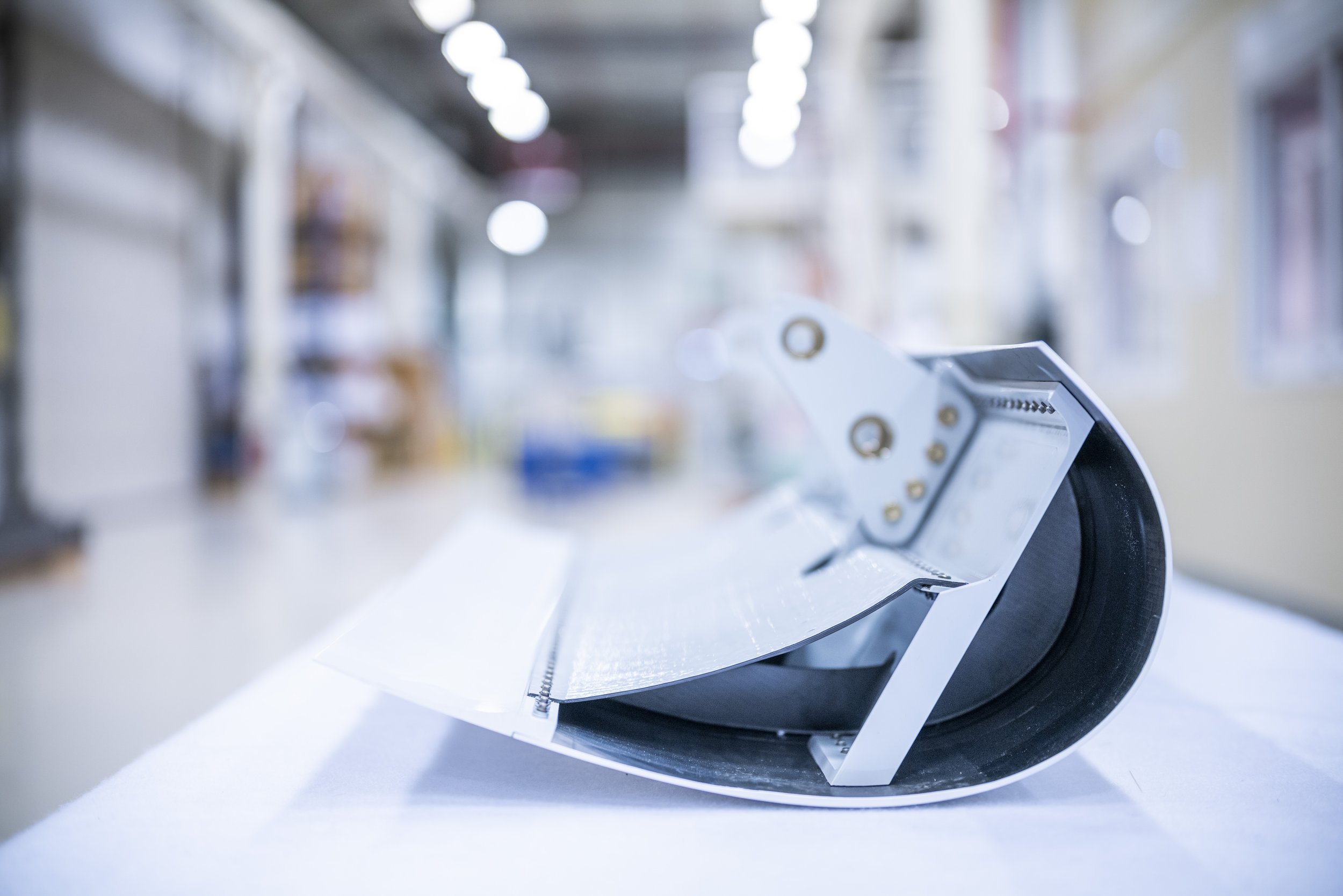
Hence the hybrid metal-composite approach. For Airbus' Wing of Tomorrow program, Montana Aerospace designed and manufactured a hybrid slat box assembly. “Two full-scale prototypes were delivered and are currently installed on the Airbus ground demonstrator in Broughton [UK],” a Montana Aerospace spokesperson says. “For Propulsion of Tomorrow, we are progressing the development of a hybrid rear secondary pylon structure, with delivery planned later this year.”
Hybrid Metal/CFRP Slat designed and manufactured for Airbus Wing of Tomorrow | Asco Belgium

Composite Structures Suppliers Pitch Techniques For Future Narrowbody
Thierry Dubois June 17, 2026 Aviation Week - Intelligence Network
Original Link: https://aviationweek.com/aerospace/manufacturing-supply-chain/composite-structures-suppliers-pitch-techniques-future
Credit: Latecoere
While launch dates for new narrowbodies to replace the Airbus A320 and Boeing 737 MAX remain uncertain, suppliers of composite aerostructures are jockeying for position. The future programs are expected to rely on higher composite material content to lessen aircraft weight.
As both airframers consider very high production rates—beyond 100 aircraft per month—manufacturability could become another crucial design driver. Specialists in large airframe and engine nacelle components—such as Aernnova, Daher, Latecoere, Montana Aerospace and Saab—as well as material providers like Hexcel are pitching new technologies and manufacturing techniques.
Automation will likely be key to next-generation aircraft production
Engineers should use composites properties to maximum advantage, material supplier says
The suppliers are doing so against a backdrop of complex dynamics. Airbus and Boeing announced the long-sought finalization of their complicated splitting up of Spirit AeroSystems in December. Reports about Boeing’s proposed takeover of Spirit emerged in the spring of 2024, and the deal, including Airbus’ part, was formally unveiled in July that year. The ongoing integration of six production sites and 4,000 employees for Airbus, as well as the combination of two factories and 15,000 employees for Boeing, could reverberate across the aerostructures industry for another few years.
Airframers will still need risk-sharing partners. However, the incorporation of Spirit adds to the insourcing trend, and work packages might shrink. The problems that Boeing faced with the high level of outsourcing on its 787 program led airframers to reverse the trend and insource across the board, Aerodynamic Advisory Managing Director Kevin Michaels says.
Airbus and Boeing would benefit from helping their aerostructures suppliers, which remain essential partners with know-how, innovation potential and a considerable industrial footprint. “Airframers must understand that their suppliers need to be profitable,” Michaels says. “Otherwise it is an own goal for the OEM.”
Suppliers will continue to struggle unless the airframers change the rules and allow an adequate return on capital. Michaels suggests that the OEMs accept higher prices, pay more quickly, impose fewer penalties over late deliveries and better account for inflation.
Automation will be central in aerostructures manufacturing for the next generation of narrowbodies. “It may bring a 5-10% cost reduction, and with single-digit margins, aerostructures specialists may find the improvement valuable,” Michaels says. “Moreover, the absence of an aftermarket means that productivity and utilization in the factory are crucial.”
For players under the pressure of current contracts, a question mark still hangs over their wherewithal to invest. Yet the upcoming programs are not be-missed opportunities.
“A chance to introduce new technologies at a broad scale happens once every 40 years,” says Lilian Brayle, president of aerospace for Europe, the Asia-Pacific, Middle East, Africa and industrial at composite material supplier Hexcel. That is thus ushering in an intense period of creativity.
Airbus is likely to be the first to launch a new narrowbody program, known internally as the next-generation single-aisle (NGSA). Suppliers agree the wing will be made of composites. “They are the baseline option for the wing, as Airbus’ Wing of Tomorrow program suggests,” says Dominique Bailly, Daher research and development director. In the UK, Airbus is testing a demonstrator that includes components supplied by Daher and Montana Aerospace.
“If Airbus goes ahead with both a wing and a fuselage made of composites, material may be procured at a lower price,” Bailly says.
Metal is still an option for the fuselage. “Metal may retain some advantages, notably in the forward fuselage section,” he says. That area is more prone to lightning and bird strikes. Composites could save 1 metric ton of fuselage weight, a major improvement, Brayle adds.
Composites account for about 15% of the weight of an A320—for the horizontal and vertical tail planes, for instance—compared with 53% on an A350, leaving room for weight reduction. On the next generation of aircraft, new composites could cut aerostructures weight 10% compared with the previous generation of composites, or 20-30% compared with metal.
Beyond the NGSA's wing material, suppliers say airframers share their intentions only rarely, sometimes indirectly and few at a time. Therefore, suppliers pitch multiple ideas for designing and manufacturing new composite aerostructures.
Montana Aerospace in Reinach, Switzerland, is conducting research and technology work on hybrid components that combine metal and composites. Montana’s expertise mainly lies in metal, and the company intends to expand its composites business.
Nevertheless, experience has encouraged its engineers to remain conservative. “We design optimized and hybrid structures that use material only where it has value,” Chief Human Resources Director Vicky Welvaert says. “We see strong potential in multimaterial solutions. We participate in developments that combine the strengths of metals and composites to achieve the best balance between performance, manufacturability and cost.”
Montana Aerospace built a prototype for a fully integrated aft pylon fairing for the 737 MAX in collaboration with the Canadian Composites Manufacturing Research and Development consortium. Produced using the resin transfer molding process, that single composite part replaced seven components. However, targeting maximum part integration does not always lead to the most cost- and rate-efficient solution, the company concluded.
That led to the hybrid metal-composite approach. For Airbus’ Wing of Tomorrow program, Montana Aerospace designed and manufactured a hybrid slat box assembly. “Two full-scale prototypes were delivered and are currently installed on the Airbus ground demonstrator in Broughton [in England],” a Montana Aerospace spokesperson says. “For Propulsion of Tomorrow, we are progressing the development of a hybrid rear secondary pylon structure, with delivery planned later this year.”
In researching composite aerostructures technologies for a future narrowbody, Aernnova is prioritizing ease and cost of manufacturing, says Miguel Angel Castillo, vice president of technology development. Current production processes proved their worth until airframers launched ambitious production ramp-up efforts. Those techniques have impeded the ramp-up, showing their unsuitability for the next generation of narrowbodies.
“State-of-the-art production technologies have limitations,” Castillo explains, citing dependence on labor-intensive processes that are prone to human error, high development costs and cycles, and related large investments. Flexible automation is one promising approach that could cover multiple processes and products, he adds.
A succession of crises over the past decade has made aircraft production rate variability a critical issue. “The ability to meet variable demand will be key, meaning we must improve our make-or-buy strategy,” Castillo says.
Saab’s engineers and executives are brainstorming, too. The manufacturer supplies composite-material ailerons for the A320 family and overwing doors for the A321. While the Swedish company has participated in various research and technology programs at the European and national level, such as in composite resins and manufacturing processes, most of its technology effort instead should focus on increasing output, asserts Magnus Falk, vice president and head of business development, marketing and sales, and commercial programs at Saab Aerospace Systems.
That raises challenging questions surrounding future production techniques. “How far can you bring artificial intelligence into quality monitoring and production flexibility?” Falk asks. “How many parts can you do on the same line? How many stations can you use? How can you improve traceability?” All those aspects are core to the mindset that the supplier will want employees to adopt so they can understand they are working on completely new rates, he adds.
Artificial intelligence (AI) could hold huge promise—as well as caveats. “You have to be careful on what level of AI you bring into production,” Falk says. “Some agentic AI may help devise a self-helping process.” Knowing more precisely where a part is in a manufacturing process could save labor hours spent searching for faults, resulting in better efficiency and higher production rates.
The jury is still out on whether the use of thermoplastic resins, with their improved manufacturability, will expand over the more established thermosets. Thermoplastic composites have advantages, such as their suitability for stamping into a net shape without the need for post-machining.
“We have demonstrated thermoplastic manufacturing with small and medium-size parts,” Brayle says. Thermoplastics also enable new shapes, thanks to automated fiber placement with unidirectional tape, and that could benefit aircraft aerodynamics.
Daher produces thermoplastic pylon fairings for the A320. Current presses accommodate relatively large parts, close to 2 × 2 m (6.5 × 6.5 ft.), Bailly says. The company is participating in a research and technology project called Spider involving press and mold manufacturers and aiming at larger dimensions. Under the French government-funded CORAC program, Spider could enable stamping of 4 × 3-m parts.
“Stamping is an economical process, especially at high production rates,” Bailly says. “The cadence with small parts, at one every 6 min., suggests large parts could be produced at a rhythm of one every 10 min. Those durations should be compared to the 8-hr. curing thermosets requires.”
For assembly, welding thermoplastics—which can take just 15 min.—is much more efficient than bolting thermosets, a sequence that starts with drilling 80 holes on the same part. Thermoplastics’ shorter production cycles could offset their main drawback: 40% more expensive resin, says Stéphane Bouzat, senior vice president of innovation and technology at Latecoere. Inspection of welded lines has yet to become a mature process, Castillo notes.
But thermosets may catch up in manufacturability. Hexcel is working on fast-cure processes for thermosets, which could be complete in 40 min. The company also is studying out-of-autoclave curing, which could save the cost of an autoclave (several million euros) as well as hours of curing cycle and energy. Stamping could be considered for some thermoset components, Bailly adds.
Future narrowbodies, compared with the 787 and A350, could feature more than an increased use of existing composites or a greater reliance on a higher-performance, high-production-rate-friendly resin: They could benefit from expanded design possibilities. “Airframers have yet to use composites to maximum advantage,” Brayle says.
The A350 and 787 benefit from the material’s lightness but use components that are similar in shape to their metal counterparts. “That is doing black metal,” Brayle says. “Engineers continued to design aircraft as if they were made of metal.” Yet composites—especially carbon fiber—enable different shapes, which may allow new architectures, he emphasizes. “I do not see how some innovative wing shapes could be made without composites,” he says.
Composite technology has matured since the A350 was designed in the 2000s. “We made advances in safety, ease of manufacturing and certifiability,” Brayle said.
With that recent progress and the need for improved performance for the NGSA, the use of composites could transform. “We are entering an era where we design with composites and for composites,” Brayle said. The change in mindset might hinge on the anisotropic nature of composites; properties can differ depending on the direction of the fibers. “You should think anisotropic from the start,” Brayle says, pointing out that the quality gives engineers more design freedom.
The Multifunctional Fuselage Demonstrator, part of the EU’s Clean Sky 2 research program, is an example of that design approach. GKN Fokker, the Netherlands Aerospace Center, Delft University of Technology, SAM XL and Diehl Aviation built the lower shell with a one-piece skin stiffened with novel omega stringers.
When designing the NGSA, engineers could extend the benefits of composites with strategic use of machine tools. “You can find synergies between the material and the machine that does the lay-up,” Brayle says. “You can maximize quality and speed of manufacturing.” Thanks to all the progress composites have made, Airbus might want composites to make up more than 60% of the NGSA airframe, he adds.
About Aviation Week
Aviation Week & Space Technology, often abbreviated Aviation Week or AW&ST, is the flagship magazine of the Aviation Week Network, a division of Informa. The bi-weekly magazine is available in print and online, reporting on the aerospace, defense and aviation industries, with a core focus on aerospace technology. It has a reputation for its contacts inside the United States military and industry organizations.
Quelle: Wikipedia

Author: Thierrey Dubios
Thierry Dubois has specialized in aerospace journalism since 1997. An engineer in fluid dynamics from Toulouse-based Enseeiht, he covers the French commercial aviation, defense and space industries. His expertise extends to all things technology in Europe.